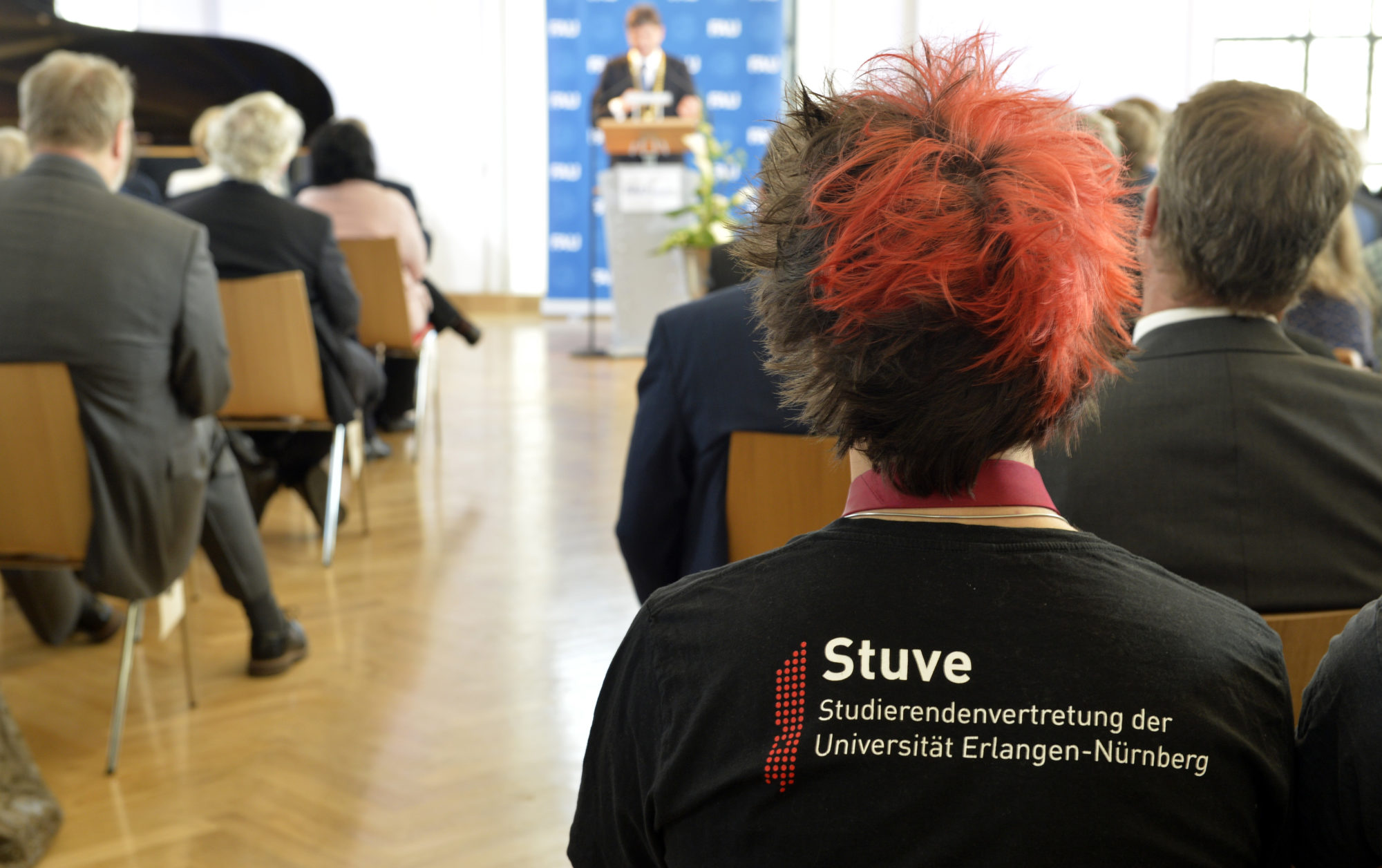

Do you want to make FAU better, represent the interests of students and develop yourself further? Then now is your chance!
Draw up a list for the 2024 university elections. You can submit your election proposal to the election office (Schlossplatz 4, 91054 Erlangen, room 2.027/2.029) until May 17, 4 p.m. You can find all the information and forms on the website of the electoral office.
So let’s go, gather like-minded people and submit your election proposal!
Invitation to the 7th meeting of the Student Council of the term 23/24 on 24.04.2024
Dear fellow students,
We cordially invite you to the next Council meeting on Wednesday, April 7th, 2024, at 6:30 pm.
The meeting will take place in room “Schwarz-Weiß-Saal”, Universitätsstraße 19.
Here you can find the preliminary agenda.
Kind regards
Emil and Alina
GEW Studis FAU on 30.04.2024: Working and studying at universities. Discussion with Andreas Keller
Universities in Germany like to advertise with brilliant slogans such as innovation, quality improvement and internationalization. However, for academic employees, student assistants and students, the working and study conditions are usually less positive or innovative: for years, fixed-term contracts, short-term contracts for assistants, and a lack of collective bargaining regulations for students have been a feature. Assistant staff, a constant increase in tasks and too low BAföG rates as well as chronic underfunding and a dilapidated infrastructure are affecting everyday working and studying life at German universities, including at FAU.
Student cycling tours
Again this semester, the student representatives are organising two bike tours for students together with the ADFC Erlangen.
On Wednesday, 24 April at 5pm, we will meet at Schlossplatz for a tour through Erlangen. We will show important places for studying, nice places to chill out and tell a few anecdotes about the city. Especially interesting for students who have only been in Erlangen for a few weeks/months/semesters.
On Sunday, 9 June (the day of the EU elections and the StUB vote), we’re going on a slightly longer tour of the surrounding area (probably towards Neunkirchen/Franconian Switzerland). Meeting point is 14h Schlossplatz.
Bring your roadworthy bike, water bottle, sun cream if necessary and a good mood! Get to know Erlangen, the student representatives and other students. Afterwards we will go to a pub or a beer garden.
We look forward to seeing you! If you have any questions, please contact paulus.istein.guter@fau.de
Proving Grounds Nürnberg 2024- Online League of Legends 04.05.2024
Dear students,
the university group E-Sports Erlangen, would like to celebrate the start of the semester with a League of Legends Online Tournament!
The Proving Grounds Nuremberg 2024 will take place this year on Saturday, May 4th from 1pm to 8pm.
Each team is required to field at least two students from the universities surrounding Erlangen/Nuremberg. The tournament will take place online, but we will accompany you through the day with a Twitch stream on our channel.
You can already register on Toornament. We are looking forward to your participation 😊
Kind regards,
Your E-Sports Erlangen
Contact us:
Registration via Discord: https://discord.gg/UtS5dvTkdG
E-mail: kontakt@esports-erlangen.de