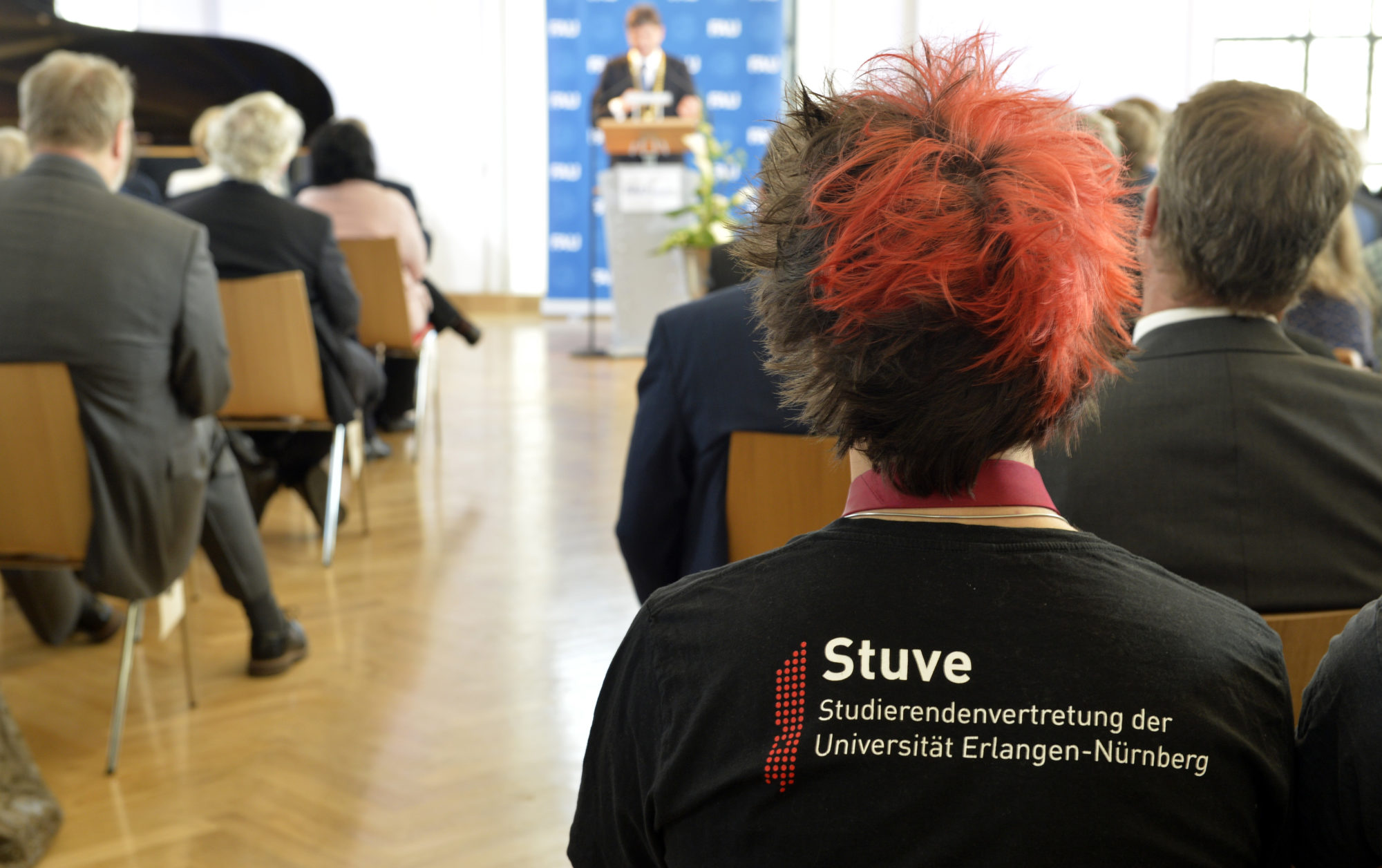
Here you can find an overview of the currently planned summer parties (as of 07.05.):
09.06. – FSI Mathe/Physik/DS, FSI Chemie/MoWi, FSI Bio/ILS – Eiweiher am Physikum (Südgelände)
11.06. – FSI Informatik – Grünfläche Martensstraße 5a (Südgelände)
17.06. – FSIen des Dep. EEI – Zwischen MHB-Gebäude und FAU-Boxen (Südgelände)
17.06. – FSI Pharmazie – Außenbereicht Chemikum (Südgelände)
18.06. – FSI CBI – Innenhof Cauerstraße 4 (Südgelände)
18.06. – FSI Jura – Wiese vor Hörsaal C (Innenstadt)
25.06. – Trichter – Innenhof Lange Gasse 20 (Nürnberg)
29.06. – FSI Germanistik – Amphitheater (Audimax)
Interview with Harriet – FAU Anti-Discrimination Officer
Many of you aren’t even aware that FAU has a central point of contact for issues related to discrimination, abuse of power, and sexual harassment—and that the barrier to reaching out is much lower than you might think. We sat down with Harriet Ziegler and asked her what exactly she does, when you can contact her, and why you shouldn’t wait until a situation has escalated.
Stuve: What do you do at FAU, and how would you describe it in two sentences?
Harriet Ziegler: My goal is to promote equal opportunity at FAU and ensure that all members of the university can conduct research and study free from discrimination. To that end, I am available as a point of contact, offering advice and support to those affected—no matter how big or small the issue may be.
What kinds of issues can students come to you about?
Whenever they feel they have been discriminated against or sexually harassed, but also in cases of bullying or abuse of power, whether by students, faculty, or staff. A situation doesn’t even have to have escalated yet: it’s better to come forward sooner rather than later.
Is there such a thing as a typical workday for you?
Not really—every day brings new challenges. Sometimes it’s about drafting guidelines; other times, counseling sessions on discrimination or abuse of power take center stage, which I clearly prioritize. On top of that, there are meetings with the Dean of Studies, the Executive Board, and other departments to find solutions together. It’s really very varied.
What kinds of issues end up on your desk that most people probably wouldn’t expect?
I actually deal with all sorts of topics that, in the broadest sense, have to do with people. A recent example is the psychological strain the war in Iran is causing among students. Mental health is becoming an increasingly important issue overall—I work at the intersection of campus communities, pastoral care, and psychological counseling.
What is the biggest misconception about diversity work that annoys you the most?
The idea that this work is simply unnecessary, based on the notion that “we don’t have any problems.” This lack of awareness sometimes manifests itself in unfriendly reactions to existing programs, and that is exactly what really bothers me.
If something happens to me at FAU—what should I do?
You can contact me by email at any time, and I’ll do my best to offer you an appointment within the same week. As a general rule: Reach out to someone you trust—that could be me, but it could also be a professor or the student council. Students in particular can contact my student representative, Janet Fuchidzhieva. You don’t need to have experienced anything specific to come see me. All conversations are completely confidential, and no action will be taken without your consent. Since I am not bound by any specific directives, I can provide advice independently of university structures.
What tools do you have at your disposal for your work?
My main tool is counseling: I show those affected possible paths forward, conduct background discussions when necessary, and, if requested, also explain external options for action.
Favorite office drink—and what does that say about you?
Tea—calming and soothing. And I also enjoy making a cup for everyone who comes to see me!
How do you stay positive in this line of work?
I have a lot of creative freedom, and that helps a lot. Plus, I see time and again that people leave our conversations feeling more positive than when they came in—even if the system isn’t perfect, it makes a difference to be able to help real people. You’ve been at FAU for over ten years.
What do you like most about it here?
The diversity! I studied theater and media studies as well as German language and literature—so it’s been very varied right from the start. What I especially appreciate about FAU is that, with so many different people and disciplines working together, something new is constantly emerging.
Last question, and a very important one: Team Desk Chaos or Team Meticulously Organized?
Definitely Team Chaos—my email inbox, by the way, too!
Workshop: Recruiting members, building cohesion: Strategies for long-term engagement in your FSI
Whether it’s the Faculty of Arts, the Faculty of Natural Sciences or the Faculty of Economics and Social Sciences: Fachschaftsinitiativen exist for a wide variety of degree programmes across all faculties. Yet their importance is often underestimated. Fachschaftsinitiativen are often the first point of contact for problems relating to studies and contribute in a special way to student life through orientation events and pub nights. However, with busy schedules and student jobs, membership numbers can vary significantly from semester to semester. Whilst some semesters see very active Fachschaftsinitiativen, in others they exist only on paper.
In this three-hour workshop, we will therefore explore what actually unites our Fachschaftsinitiativen. From this, we will develop strategies for strengthening cohesion within our Fachschaftsinitiativen in the long term and, in doing so, motivating new students to get involved. We invite students from all faculties who are currently involved in an FSI, have been involved in the past, or are interested in getting involved. No prior knowledge is required. In cooperation with the Teaching Competence Centre, participants will receive an official certificate of attendance following the workshop.
Date: 15 May 2026, 2.00 pm – 5.00 pm
Venue: Student Union Building, Turnstraße 7, 91054 Erlangen
Facilitator: Selim Küçükkaya
Registration via StudOn
Invitation to the 5th meeting of the Student Council of the term 25/26 on 25.02.2026
Dear fellow students,
We cordially invite you to the next meeting on Wednesday, February 25, 2026, at 6:30 p.m. The meeting will take place online via Zoom. The preliminary agenda is available here.
Best regards,
Jonathan and Dennis
Socially committed women* wanted for Safe Space at the Berg
As in previous years, the Erlangen Women’s Emergency Hotline, together with the City of Erlangen, is looking for socially committed women* for the “Safe Space” contact point for girls and women* for the next Bergkirchweih in Erlangen (May 21–June 1).
What can you expect?
• A weekend training course (dates: May 8 and 9) with professional and practical input on violence prevention and sexual violence
• A free WEN DO course (choose from May 16 or May 17, 2025)
• Flexible shift scheduling, support, and supervision by professional staff during shifts. Shifts are from 5:00 p.m. to 9:00 p.m. or from 9:00 p.m. to midnight.
• Follow-up (date: June 9, 2026)
What should you bring with you?
• You are confident in approaching people and drawing their attention to the support services available.
• You are able to deal with girls and women in special circumstances or situations.
• You are empathetic and creative.
• You are good on your feet.
• You have a background in social work, education, psychology, medicine, or a degree in humanities or social sciences.
Have we piqued your interest?
Then we look forward to hearing from you with a short description of yourself and your motivation for participating in the contact center. If you have any questions, please feel free to contact us.
Contact:
buero@frauennotruf-erlangen.de
www.frauennotruf-erlangen.de